

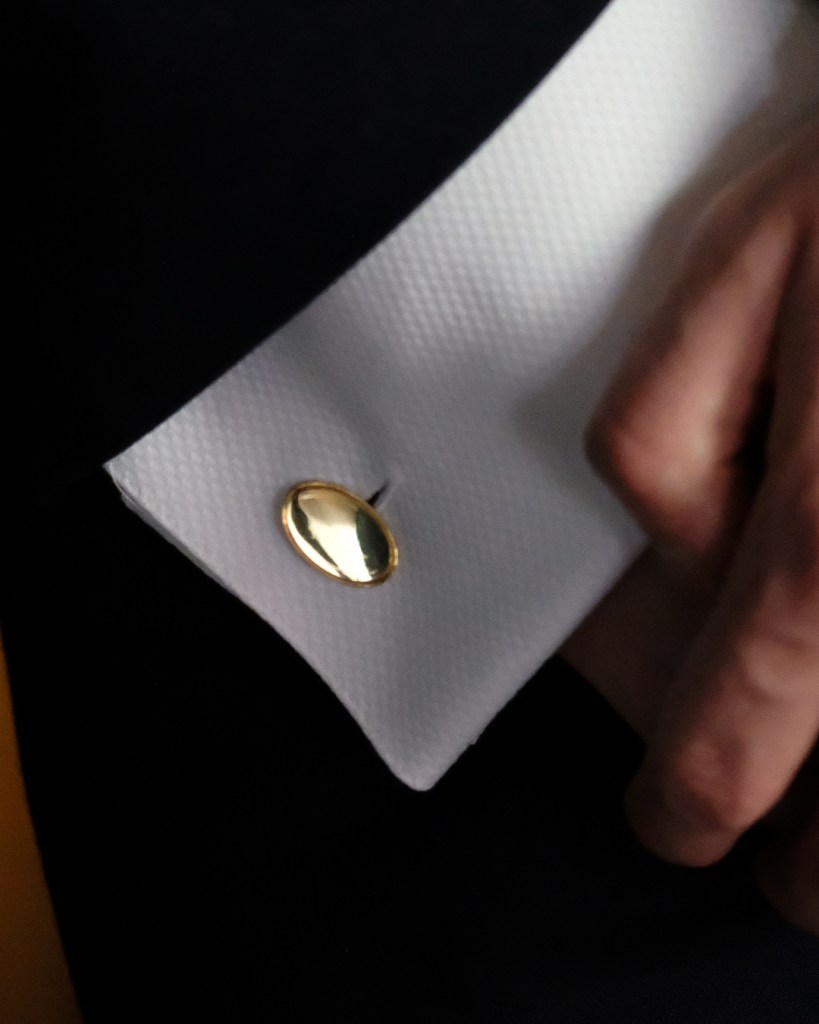




When it comes to cufflinks, classic style neve fades. Bold, yet refined primary colours have remained favourites for centuries. As the foundation of all other colours, they are a natural starting point for designers and artisans alike.

The Art of Primary Colours
“The Mondrian Effect” refers to Piet Mondrian’s minimalist abstractions of grids from black lines and blocks of primary colours, sought to convey universal harmony through simplicity. He used primary colours to express feelings and balance, stripping art down to its most basic elements while still creating visually interesting compositions.
Each primary colour carries its own distinct meaning:
- Red symbolises power, confidence, and passion
- Blue signifies trust, calmness, and professionalism.
- Yellow embodies creativity and warmth.
In fashion, stylists often recommend coordinating colours with different accessories such as a cufflink, tie or pocket square to create a look that feels intentional and effortlessly put together. Cufflinks go beyond functionality, they are a refined expression of personality and taste which began very far back.

17th Century

18th Century
19th Century
20th Century
Modern Day
Shirt cuffs were originally tied with ribbons, but as men’s fashion refined and grew in sophistication a more decorative, practical solution was needed. During the 1660s, King Charles II popularised “sleeve buttons”, two ornamental buttons connected by a small chain. They became a symbol of status and wealth elevating them beyond functionality.
Often crafted from silver or gold and embellished with gemstones and vivid colour, cufflinks evolved into symbols of opulence. They were frequently gifted to mark special occasions and milestones, reinforcing their status as luxury items.
As time progressed and industrialisation developed cufflinks transformed from handcrafted luxury pieces into items that could be mass produced, making them more widely available. Demand increased further during the Victorian era, as stiff, heavily starched shirts made traditional buttons impractical.
This century witnessed remarkable artistic innovation exploring Fauvism and Expressionism, Cubism and Futurism. Experimenting with colour and bold geometric abstraction which was also applied to cufflinks. This era of innovation brought about the snap together cufflink which made it much easier for daily use.
Today, cufflinks are worn for both formal and casual occasions and are crafted in countless designs. What began as simple ribbons has evolved over centuries into an accessory that blends elegance, personal style, and a pop of colour.

Modern Trends and Contemporary Design
Coloured enamel has become a hallmark of contemporary sophistication. Today’s designers are embracing primary colours with renewed boldness, often pairing them with precious metals like gold and silver to enhance contrast and visual appeal.
Primary colours continue to endure in men’s fashion offering a natural contrast against neutral white shirts and tailored attire. Colour theory is not about rigid rules but about understanding how hues interact. Understanding these relationships allows cufflinks to become more than accessories, they become confident expressions of style.
To explore how primary colours can elevate your own style, discover our collection at ENAMELLED CUFFLINKS – Benkes of England.